
I was on the customer service line at Best Buy to return a pair of headphones when I first saw it: the intersection between technology and personalized medicine. Ok, so it actually first broke through to the mainstream market on the back of the Wii platform via Wii Fit, but this wasn’t just another healthcare game. As I stood in line, I looked at the wi-fi enabled scale and the electronic sleep monitor disguised as a bracelet, brought to you by FitBit.FitBit is a tracking device, which allows the user to measure steps taken, calories burned, stairs climbed, and quality of sleep, an extension of the performance monitors athletes have been using for years.
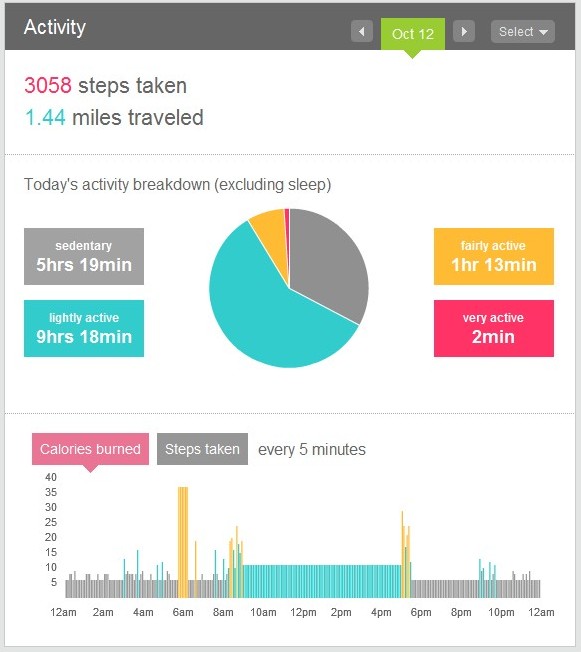
FitBit Dashboard
To me, the question wasn’t as much about whether I wanted one (I did, and have since bought the FitBit One tracker and FitBit Aria wi-fi scale), or whether others did, but how does this tool fit into the grand scheme of things?
The origin of this question actually had nothing to do with my encounter with the FitBit. In fact, it occurred to me after having read an article about the top apps in healthcare. The article cited a study of more than 15,000 apps that currently exist under the category of healthcare. 15,000! Realistically speaking, they don’t all serve the same purpose, address the same issues or even target the same set of users. These 15,000 apps can be broken down into a variety of sub-categories, including drug reference, communication, medical education, EMR access, among others. At the same time, both the disparity in sub-categories and the sheer mass of apps brought to mind the question: how do all these tools (some actually impressive, useful even) play together? The biggest dilemma that healthcare is dealing with is not a lack of solutions, or a lack of participants. In fact, there are too many players, and that is exactly what has created the problem. Our system is fragmented into providers, payers, pharmaceutical and healthcare technology companies, and academia, and no one speaks the same language.
I appreciate the healthcare information exchange initiative, and its purpose to create a common language, but it still focuses only on creating a common language for a single sub-sector. I liken this initiative to the different regions in India, each with their own dialect, but capable of communicating with one another with a common language despite their differences. The difficulty is that countries outside of India each have their own language, which then requires a common language to enable communication between countries. While the process starts with communication within a country, or sub-sector, it needs to transcend sub-sectors. In her book, Make Your Mark!, Dr. Freda Lewis-Hall calls for metacollaboration. By metacollaboration, Dr. Lewis-Hall means cross-industry collaboration to ensure better, more integrated solutions. I wholeheartedly agree. We need to start speaking a common language, between and across sectors and stakeholders. The function of technology shouldn’t be to just share or aggregate information, but enable greater integration across informational components. So whether it’s a consumer-oriented app, or a sector-specific innovation, the role technology should play is one that simplifies and integrates. To that vain, I look forward to the next generation of gadgets and gizmos that allow me to consolidate my footprint rather than expand it, and make me feel empowered rather than overwhelmed.
 I <3 Healthcare